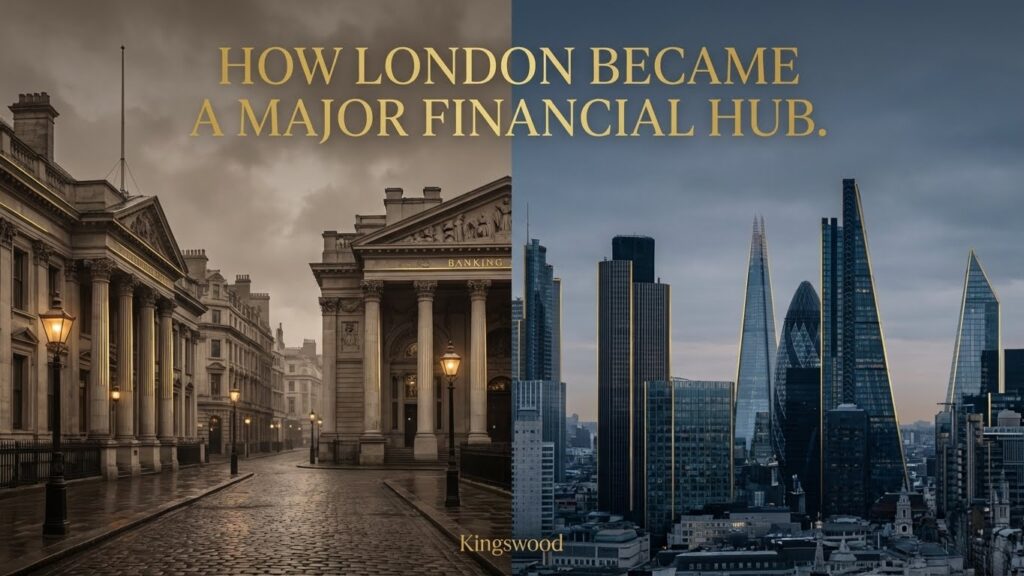
How London Became a Major Financial Hub
London’s Global Positioning
London’s standing among the world’s major financial centres is not a product of aggressive marketing, nor the result of a short-lived boom. It is the outcome of centuries of accumulated infrastructure, legal certainty, connectivity advantages and institutional credibility. Today, London intermediates more of the world’s cross-border banking flows than any other jurisdiction, and close to forty percent of global daily foreign-exchange turnover occurs in the London marketplace. In most recognised global financial centre rankings, London sits beside only New York at the top of the hierarchy.
Yet London’s influence is subtle rather than spectacular. It is not a city that needs to announce itself; it functions quietly as a global co-ordinator of capital, bridging Asia’s late trading hours with North America’s early morning, hosting the world’s deepest pool of international advisors, and providing a regulatory environment that global institutions trust over political cycles. Its global role is not defined by short-term trends but by structural conditions that have matured over centuries.
Historical Foundations: From Merchant Port to Imperial Clearing House
The origins of London’s financial dominance lie in commerce rather than financial engineering. Between the sixteenth and eighteenth centuries, London evolved from a merchants’ port into a bustling centre of trade. Its population expanded dramatically—from around 50,000 in the early 1500s to more than a million by 1800—fuelled by maritime commerce and the influx of traders, bankers, insurers, and artisans from across Europe.
Merchant guilds and livery companies helped establish a culture of credit discipline, contract fidelity and professional organisation. By the late seventeenth century, these practices were institutionalised with the founding of the Bank of England in 1694. The Bank’s capacity to raise funds for government spending and provide an anchor for public credit laid the foundations of modern central banking.
Around this institutional core, London’s early market infrastructure formed organically. Brokers gathered in coffee houses—one of which evolved into the London Stock Exchange. Marine insurers congregated at Lloyd’s Coffee House, eventually creating the world’s most recognised insurance marketplace. Discount houses financed short-term trade, and acceptance houses underwrote international bills of exchange, allowing London to finance global commerce at scale.
The rise of the British Empire accelerated London’s centrality. By the mid-nineteenth century, London was the financial heart of a global trading system. Britain carried a large share of the world’s freight, and its banks were embedded in every significant commercial port, enabling London to act as the global clearing house for trade finance. Walter Bagehot described Victorian London as “the great settling house of exchange transactions,” a city whose financial reach grew naturally out of the empire’s vast economic geography.
This early architecture—merchant discipline, legal sophistication, imperial reach—created a financial culture that prioritised clarity and reliability. Much of that ethos persists today.
Legal and Institutional Architecture: The Quiet Power of English Common Law
One of the most enduring pillars of London’s attractiveness is its legal system. English common law emphasises precedent, judicial independence and commercial predictability. For international investors, this reduces uncertainty—not just about immediate transactions, but about the settlement of disputes and the treatment of property over time.
Common law’s flexibility enables sophisticated structuring without necessitating highly prescriptive rulebooks. Cross-border contracts, even between non-UK entities, are often governed by English law because the system is perceived as commercially rational, impartial, and resistant to political interference. The UK judiciary—professional, apolitical and globally respected—strengthens this trust. In high-stakes financial disputes, parties expect the English courts to understand complex instruments and rule consistently.
London’s institutional layer further anchors this legal foundation. The Bank of England has provided lender-of-last-resort stability since the seventeenth century. The London Stock Exchange and its associated clearing systems have operated under transparent and orderly frameworks for centuries. While regulation evolves, London’s regulatory tradition is characterised by continuity rather than volatility—a quality global investors prize. London’s ability to combine robust oversight with commercial pragmatism has made it a jurisdiction where capital feels protected, yet not suffocated.
Currency Power and the Legacy of Sterling
For much of the nineteenth and early twentieth centuries, London’s place in global finance was inseparable from sterling’s dominance. Under the classical gold standard, sterling served as the world’s primary reserve and settlement currency. Bills drawn on London circulated around the globe, and London banks acted as central counterparties in international trade.
After the First World War, the dollar gradually displaced sterling, but the process was slow and incomplete. Even today, the pound remains one of the world’s most widely used currencies for payments and reserves, sustained by the deep currency and derivatives markets centred in London.
This continuity matters. It means that London retains a powerful infrastructure for clearing and settlement, not only in sterling but in multiple major currencies. Systems such as CHAPS and CLS handle vast volumes of FX flows, while Eurobond and swap markets—many of which were born in London—continue to operate on sterling-adjacent platforms.
London’s currency ecosystem functions as a bridge: a sterling centre with deep multi-currency capability. This dual heritage—sterling’s historical footprint combined with the city’s role in managing dollar and euro liquidity—helps explain London’s enduring centrality.
The Eurodollar Revolution: London’s Second Transformation
If sterling created London’s first financial empire, the Eurodollar market created its second. After the Second World War, U.S. domestic financial regulations—interest-rate ceilings, capital controls, and reserve requirements—encouraged banks to conduct dollar business offshore. London offered the ideal environment: credibility, a respected legal framework, and regulation that did not impose U.S.-style restrictions on foreign-currency deposits.
Throughout the 1950s and 1960s, Eurodollar deposits and loans surged. Global banks established London branches, and offshore dollar finance grew to rival U.S. domestic markets. By the 1970s, London was the world’s central platform for cross-border dollar transactions, hosting more than a quarter of global banking claims. The city became the hub where global borrowers found dollar funding and where institutions managed liquidity beyond the reach of U.S. regulatory constraints.
From this offshore ecosystem emerged modern Eurobond markets, syndicated loan structures and eventually derivatives trading. The Eurodollar era allowed London to transcend its reliance on sterling and integrate itself into the architecture of the U.S.-led global monetary system—without being bound by U.S. domestic controls.
This transformation elevated London from imperial financial capital to modern global marketplace.
Time Zone and Connectivity: The Architecture of a 24-Hour Market
London’s geography provides a distinct strategic benefit. Situated between Asia and North America, the city overlaps with both trading days. This mid-zone positioning ensures that London functions as the hinge of the global financial clock.
In practice, this means that:
- Asian markets are still active when London opens
- European markets run concurrently with London
- U.S. markets open during London’s afternoon
The London–New York overlap is consistently the most liquid period of global FX and derivatives trading. For global institutions managing portfolios across multiple continents, this overlap reduces friction and allows comprehensive risk management within standard working hours.
Connectivity strengthens this advantage. London’s telecommunications infrastructure supports high-frequency trading across major asset classes. English, as the language of international finance and law, simplifies coordination. Heathrow and the city’s transport networks connect London’s financial districts with the world’s major financial hubs, supporting near-continuous interaction.
Few cities can match this triangulation of time, language, and connectivity.
Human Capital and the Power of Financial Clustering
London’s financial system is defined not only by institutions but by the concentration of talent that operates within them. Hundreds of thousands of professionals work in banking, asset management, insurance, legal services, consulting, and accountancy. This density creates a dynamic labour market where specialists across sectors—corporate law, tax optimisation, risk modelling, structured finance—circulate within the ecosystem.
Universities such as the LSE, Imperial, and London Business School attract global talent, many of whom remain in the city. This produces a cosmopolitan professional culture that is comfortable operating across borders and asset classes.
Physical clustering amplifies these advantages. The City of London houses the Bank of England, the LSE, Lloyd’s of London, and the headquarters of major legal and professional services firms. Canary Wharf, developed from the late 1980s onward, offers world-class trading floors and corporate towers for major global banks. High-capacity digital networks connect the two districts seamlessly, creating a unified marketplace despite their physical distance.
Agglomeration effects—where proximity reduces friction and enhances collaboration—allow London to handle large, complex transactions with uncommon speed. A sovereign debt restructuring, multinational merger, or cross-border trust arrangement can be structured efficiently because the required expertise is concentrated within a few square miles.
London in Comparative Perspective
London’s role becomes clearer when viewed against its competitors. New York offers unmatched domestic capital markets and benefits from the scale of the U.S. economy. Singapore and Hong Kong serve as Asia’s gateways, with strong legal frameworks and dynamic regional markets. Zurich and Frankfurt excel in stability, prudence and specialised banking.
However, no other centre combines London’s features in one marketplace:
- a common-law system trusted worldwide
- deep multi-currency markets
- global advisory capability
- physical and temporal connectivity between Asia and America
- a legacy of both sterling and U.S.-dollar expertise
- a professional ecosystem spanning law, tax, banking, and wealth strategy
Asian hubs offer rapid growth but are influenced by regional political dynamics. Continental European centres provide regulatory stability but lack London’s global reach. New York, for all its scale, interacts less directly with Asian markets due to its time zone.
This is why London and New York remain the world’s two global financial poles, while the rest serve as regional anchors.
The Future of London’s Financial Centre
London’s long-term position will depend less on promotional campaigns and more on maintaining the conditions that built its resilience. Judicial independence, openness to global talent, regulatory clarity, and stable policy direction will all determine whether London retains its structural advantages.
Technological change—fintech, digital assets, tokenisation, AI-driven trading—will reshape financial markets. London’s historical flexibility, from its early stock-market innovations to the transformative “Big Bang” reforms of 1986, suggests that it is capable of adapting without sacrificing institutional credibility.
For investors, entrepreneurs, and internationally mobile wealth-holders, London’s value lies in its discretion, its stability, and its ability to integrate legal, financial, and advisory services in a single location. As long as it preserves the fundamentals—rule of law, openness, and professional depth—London will remain a central node of global finance.
In a world of shifting geopolitics and evolving markets, the city’s quiet strengths—clarity, structure, and international reach—position it not merely as a legacy centre, but as a durable platform for wealth strategy and global structuring for decades to come.