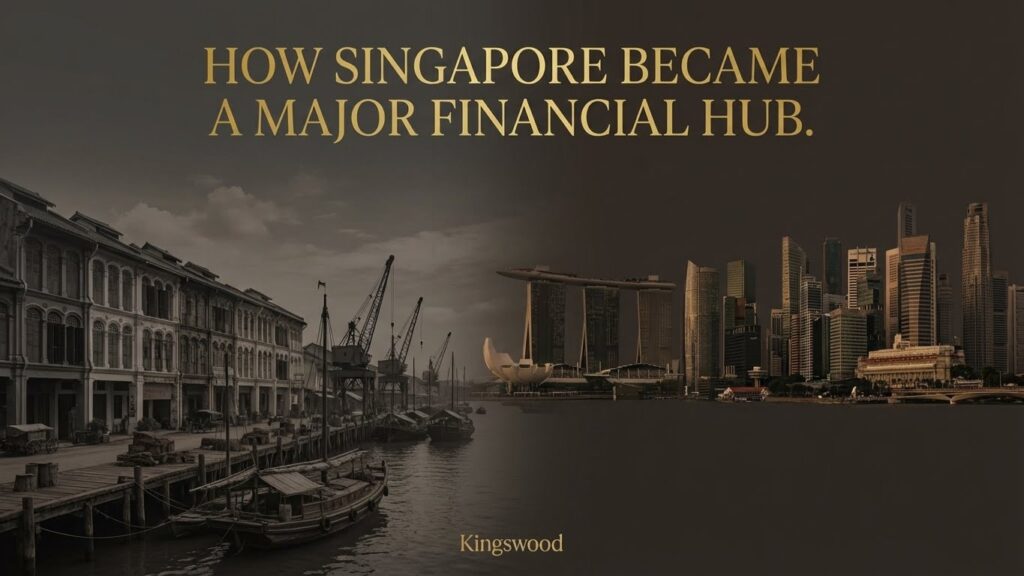
Singapore’s Emergence as a Global Financial Hub
Singapore’s transformation from a colonial trade port into one of the world’s preeminent financial centers is the result of deliberate long-term strategy, prudent governance, and strategic policies. In just a few decades since independence in 1965, the city-state has built on its geographic advantages and stability to attract capital and talent. Today, Singapore’s financial sector is a cornerstone of its economy, contributing roughly 13–14% of GDP and managing trillions in assets for investors worldwide. In absolute terms, Singapore’s financial sector contributed about SGD 87.8 billion to GDP in 2024, reflecting its central role. The country also attracted roughly US$159.6 billion in foreign direct investment in 2023, underscoring continued international confidence.
Historical Foundations and Strategic Vision
Singapore’s roots as a financial hub date back to its days as a British trading post. Its prime location at the mouth of the Malacca Strait made it a natural node for commerce. By independence, however, Singapore had virtually no natural resources; this vulnerability prompted the government to pursue an export- and services-led strategy. Under founding Prime Minister Lee Kuan Yew, Singapore leveraged its port heritage by developing financial services for Asia-Pacific trade. Early on, Singapore positioned itself as Asia’s financial crossroads. For example, after the collapse of the Bretton Woods system in 1971, authorities moved quickly to cultivate an Asian Dollar Market. Over the next two decades, targeted initiatives – such as tax breaks for fund managers and internationalizing the Singapore dollar – nurtured an asset management industry. These strategic steps gradually converted Singapore’s trading legacy into a robust financial economy.
Stable Governance and Business-Friendly Regulation
A cornerstone of Singapore’s appeal is its political and legal stability. The continuity of government and strict rule of law give global firms confidence in the market. Singapore enjoys one of the highest sovereign credit ratings (AAA) in the world. Its net public debt is effectively zero (government assets far exceed liabilities), underscoring the government’s strong fiscal health. As the Economic Development Board notes, “political stability, low corruption rates, and transparent public institutions have underpinned [Singapore’s] growth as a leading business and financial hub in Asia.”
The country’s regulatory framework is deliberately pro-business. Capital-market, banking and fund licensing can often be approved within a few months. The MAS (Monetary Authority of Singapore) also provides grants and tax incentives (via its Financial Sector Development Fund) to encourage global banks and asset managers to expand in Singapore. These measures keep entry costs low.
Singapore’s legal and tax systems further support finance. The city-state operates under an English-common-law system and maintains an extensive network of double-tax treaties (over 100 worldwide), facilitating international transactions. Its corporate tax rate is a competitive 17%, and special schemes (such as the MAS Financial Sector Incentive and wealth-management concessions) make the overall tax burden relatively low. This clear, efficient environment – high signal, low noise – is one reason global firms base their Asian operations in Singapore.
World-Class Financial Infrastructure
Singapore has invested heavily in building financial infrastructure. The Singapore Exchange (SGX) today has a market capitalization of around US$644 billion (2025), larger than any other stock market in ASEAN. Its major local banks (DBS, OCBC, UOB) have grown into global institutions; together they hold over US$1.6 trillion in assets. At the same time, Singapore is a hub for trading and investment flows: in 2022 it averaged almost US$1 trillion in daily foreign-exchange trading, making it Asia’s largest FX hub and third-largest globally.
Singaporean asset managers held about US$3.6 trillion in assets under management by 2022, with roughly three-quarters of those funds sourced from overseas. These scale metrics underscore Singapore’s role as a bridge for global capital into Asia. The domestic capital markets are also robust: in 2022 about US$141 billion of corporate bonds were arranged in Singapore, including roughly US$7.5 billion of green and sustainability bonds. Likewise, Singapore’s insurance industry is significant: by 2023 it hosted 217 insurers writing about US$2.1 billion in general insurance premiums.
Investments in talent and connectivity buttress this infrastructure. English is the working language, and top-tier universities (NUS, NTU, INSEAD, etc.) and training programs ensure a steady supply of finance professionals. Singapore ranked #2 in the 2023 Global Talent Competitiveness Index and topped international education assessments, helping to produce world-class talent. Its multicultural, high-standard living environment also attracts skilled expatriates. Meanwhile, first-class transport and telecommunications networks connect Singapore globally. This unmatched connectivity allows financial institutions to operate throughout Asia from a single base.
Competitive Advantages
Singapore’s enduring status as a premier financial center rests on a combination of strengths. Its political stability and robust rule of law are often cited as the bedrock of its finance sector. On this solid foundation, several competitive advantages stand out:
Regulatory strength: Singapore is consistently ranked among the top financial jurisdictions worldwide. It placed 4th in the 2024 Global Financial Centres Index, ahead of many regional rivals. The MAS is highly respected for clear, well-enforced regulations and strong risk oversight.
Favorable tax environment: Corporate tax is capped at 17%, lower than many peers, and targeted incentives further reduce costs. For example, the Financial Sector Incentive (FSI) scheme grants reduced tax rates to eligible banks and fund managers. Special concessions for family offices and wealth funds make Singapore an efficient hub for global capital.
Skilled talent pool: Singapore employs roughly 190,000 finance professionals (among the largest concentrations in Asia). Top-tier universities and professional programs graduate specialists in banking, asset management and fintech. Liberal visa and scholarship policies also attract experienced international talent.
Infrastructure and connectivity: State-of-the-art infrastructure underpins operations. Changi Airport and a world-class port connect Singapore globally, while the country boasts some of the fastest internet speeds on earth. This unmatched connectivity means firms can conduct business across the region from a single, efficient base.
These factors combine to create a “high signal, low noise” environment – efficient and reliable for strategic investors. They reflect Singapore’s broader philosophy of practical, structured growth rather than speculative hype.
Gateway to ASEAN and Global Markets
Beyond its domestic economy, Singapore serves as a gateway for capital flowing into Southeast Asia. Its financial institutions facilitate cross-border trade finance and corporate expansion throughout ASEAN. Many multinationals and private investment firms establish regional headquarters or treasury centers in Singapore to leverage its deep liquidity and legal protections.
The city also proactively offers residency and wealth-management frameworks to the globally mobile wealthy. For example, the Global Investor Programme offers permanent residence to foreign entrepreneurs or fund managers who invest substantial capital (typically tens of millions of USD). Singapore also has no capital gains or inheritance tax, and an extensive treaty network. These features make Singapore a discreet, tax-efficient haven for ultra-wealthy families managing global assets.
Challenges and Outlook
Singapore’s leading position is not guaranteed, as the landscape continues to evolve. Competing hubs have risen rapidly: within ASEAN, cities like Bangkok, Jakarta and Kuala Lumpur are aggressively building up their banking and fintech sectors. Hong Kong and Shanghai remain major centers for China-related finance, even as Singapore captures a growing share of Asia’s business.
At the same time, technology is reshaping finance. Fintech, blockchain and digital banking offer new efficiencies that could disrupt traditional models if they are not embraced. Singapore’s authorities have responded by adapting policies. The MAS actively funds fintech research, issues digital banking licenses and has positioned the city as a regional center for green and sustainable finance. These moves are intended to keep Singapore at the frontier of financial innovation. In fact, Singapore’s FinTech ecosystem is widely recognized: one study ranked it first in Asia and fourth globally among FinTech hubs. As one observer notes, Asia’s share of global currency trading has been rising, and “the centre of gravity is moving closer to Asia.” That trend underlines Singapore’s continuing strategic role in the global financial system.
In summary, Singapore’s ascent to a major financial hub is the product of decades of steady statecraft. Its geographical location and port history provided a foundation, but it was the city-state’s disciplined policies – political stability, clear regulations, talent development and global integration – that truly built its financial center. By continuing to strengthen these pillars while embracing innovation, Singapore appears well-positioned to remain a top-tier global financial center for decades to come. It remains a model for cultivating a high-quality financial ecosystem through disciplined strategy rather than hype.