Historic Private Members’ Clubs: Origins, Influence, and Enduring Legacy
Private members’ clubs occupy a distinctive place in the social history of the modern world. More than mere dining rooms or lounges, they functioned as incubators of political power, cultural exchange, and elite sociability for over three centuries. Their story begins in the hum of 17th-century London coffeehouses and evolves into a global phenomenon that left its mark on the political economies of Britain, its empire, and other aspiring elites around the world. Though often portrayed as quaint relics of a bygone aristocratic age, these institutions continue to hold a quiet yet formidable influence today.
From Coffeehouses to Clubland: The Origins
The earliest prototypes of private clubs emerged in London during the late 1600s. At a time when literacy was rising and newspapers were increasingly available, coffeehouses became vibrant public spaces where merchants, writers, financiers, and gentlemen met to discuss news, conduct business, debate politics, or simply socialize. Over time, certain coffeehouses developed specialized clienteles: one might cater to stockjobbers, another to naval officers, another to literary men. These informal communities eventually crystallized into more permanent institutions.
The transition from coffeehouse to club was gradual but significant. Members sought privacy, comfort, and exclusivity—conditions hard to maintain in public establishments. By the early 18th century, several groups formally organized themselves into what became recognizable gentlemen’s clubs. White’s, founded in 1693 as a chocolate house, is widely considered the oldest of these institutions and soon developed a reputation as a gambling den for aristocrats. Brooks’s (est. 1764), associated with the Whigs, and Boodle’s (est. 1762), frequented by the Tory gentry, followed suit. These early clubs served as quasi-political headquarters where powerful families and factions gathered to strategize, debate, and reinforce their networks.
The idea of “clubland” began to flourish in the Regency and early Victorian eras. Around St James’s Street and Pall Mall, an extraordinary concentration of clubs arose, turning a small London district into the social nerve center of the British elite. These institutions typically featured libraries, dining rooms, billiard rooms, card rooms, smoking lounges, and private chambers. Admission was strictly controlled by secret ballot—often requiring multiple proposers, impeccable reputation, and sometimes decades of waiting. The environment cultivated a sense of belonging and pedigree that money alone could not buy.
The Golden Age of Clubs in the 19th Century
The 19th century marked the explosion of club culture. Industrialization, imperial expansion, and London’s role as the world’s financial capital created a vast new class of influential professionals—civil servants, military officers, colonial administrators, scientists, and wealthy industrialists—who sought the social structure and prestige that clubs provided.
New clubs with specific missions began to appear. The Athenaeum Club (1824) became a home for the intellectual elite: scientists, authors, explorers, academics, and reformers. Its founders included prominent figures such as Humphry Davy and Michael Faraday. The Reform Club (1836) was established by political liberals and became a hub for progressive thinkers, civil servants, and travelers. The Travellers Club (1819) catered to those who had journeyed abroad, especially diplomats and foreign correspondents. The Garrick Club (1831), named for the renowned actor David Garrick, attracted painters, actors, writers, and theatrical personalities.
By the mid-Victorian period, London boasted over 400 private clubs—a number that dwarfs today’s count of fewer than 40. Membership often ran in families, tying careers and social relationships into a tightly woven fabric of influence. For many men of the Establishment, a club was an extension of home, office, and university: a quiet refuge where they could dine, socialize, read the papers, and engage in the subtle games of diplomacy and relationship-building that defined elite life.
Architecture, Ritual, and Aesthetic: The Experience of the Classic Club
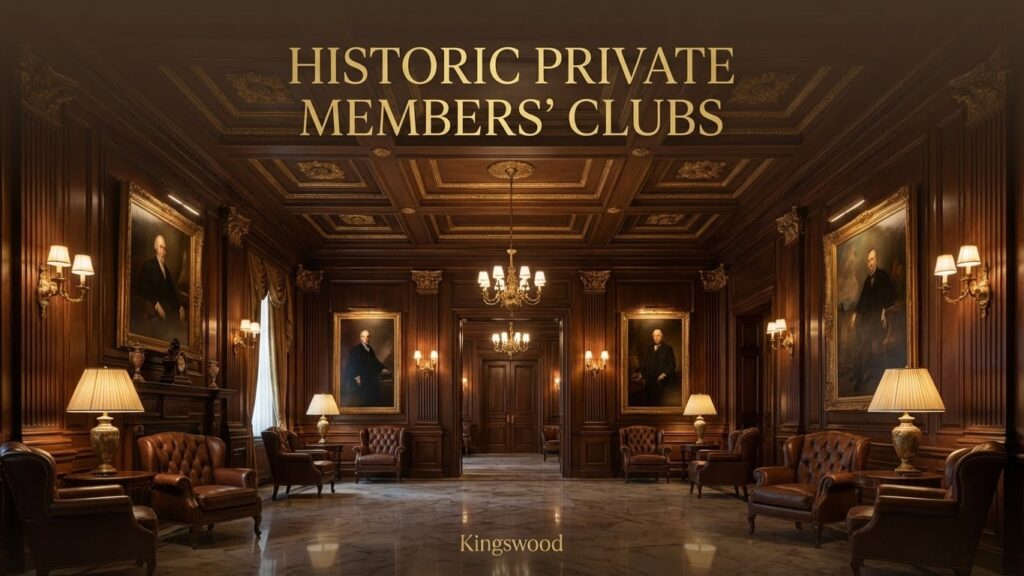
The physical form of a private club was as important as its membership. Many 19th-century clubs were built as imposing neoclassical or Italianate palaces, designed by leading architects. The Athenaeum’s Pall Mall facade, with its broad portico and statue of Athena, projected the intellectual stature of the institution. White’s austere townhouse on St James’s Street emphasized its tradition and exclusivity. Inside, the club was designed to facilitate both privacy and sociability: reading rooms lined with thousands of volumes, hushed libraries, drawing rooms with deep leather armchairs, and dining halls paneled in mahogany.
Meals were central to the ethos of club life. Members dined on classic English fare—roasts, game, soups, fish dishes—served by long-tenured staff who often spent decades in service. Dress codes reinforced decorum: suits by day, black tie for special occasions, and no casual attire. Many clubs imposed rules against discussing politics or religion at the table, reflecting a desire to maintain civility and discretion.
This “quiet luxury,” rooted in understatement rather than ostentation, gave clubs their distinctive charm: an environment where tradition, comfort, and continuity overshadowed fashion and novelty.
Global Spread: Empire, Imitation, and Cultural Exchange
As the British Empire expanded, so too did the club model. British administrators, officers, and businessmen transplanted the idea of the private club to colonial capitals. These institutions often replicated London’s standards—dress codes, membership rules, architectural forms—and became centers of local elite society.
In India, clubs such as the Bengal Club (Calcutta, 1827), Madras Club (1832), and Bombay Gymkhana (1875) served as social anchors for colonial officers and businessmen. They were often racially exclusive in the early years, admitting Indians only later as independence movements rose.
In Australia, the Australian Club (Sydney, 1838) and the Melbourne Club (1838) brought London’s club ethos to the colonial frontier, offering refined dining, reading rooms, and a sense of belonging for judges, landowners, and politicians.
In Canada, the Rideau Club (Ottawa, 1865) and Montreal’s St. James Club (1857) played similar roles for the dominion’s political and business leadership.
In the United States, club culture developed its own character. Inspired by British institutions but shaped by American wealth, New York, Boston, Philadelphia, and Chicago developed clubs for industrialists, financiers, lawyers, and statesmen. The Union League Clubs (New York, Philadelphia, Chicago) were founded during the Civil War to support the Union cause, blending politics with aristocratic style. The Metropolitan Club (New York, 1891) was founded by J.P. Morgan and other magnates to create a grand, apolitical environment for business and social life.
Elsewhere, from the Tanglin Club in Singapore to the Hong Kong Club, the concept travelled wherever British influence, commerce, or expatriate communities thrived. Even nations outside the empire, such as Russia, adopted similar models: the Angliskoye Sobranie (“English Club”) in Moscow, founded in 1772, became a cultural hub for the Russian nobility.
Influence and Power: The Hidden Networks
The enduring fascination with private clubs stems not only from their decor and tradition, but from their role in shaping politics, business, and society. In eras where formal institutions were constrained by protocol or public scrutiny, private clubs provided a discreet venue for candid discussion.
Political alliances were forged in card rooms. Business deals were negotiated over lunch. Literary and scientific breakthroughs were debated in libraries. In some cases, clubs influenced state policy more directly: parliamentary bills were drafted over brandy at Brooks’s; banking strategies were coordinated at the Metropolitan; colonial appointments were discussed at the Travellers or Reform.
Clubs provided an “invisible architecture” of influence—connections that did not appear in public records but mattered profoundly in shaping careers and decisions. Members often formed lifelong bonds rooted not in transactions but in shared ritual and belonging.
Iconic Clubs and Their Distinct Personalities
A handful of clubs have transcended their origins to become symbols of tradition and exclusivity:
White’s (London, 1693)
Famous for its betting book and long heritage, White’s retains an aura of mystery. Its membership has historically included prime ministers, dukes, and members of the royal family. Even today, its invitation-only admissions and conservative traditions make it emblematic of aristocratic club culture.
Brooks’s (London, 1764)
The historic Whig club, known for political intrigue, high-stakes gambling, and its rolodex of influential statesmen. It was home to figures such as Charles James Fox and later a meeting place for liberal politicians.
The Athenaeum (London, 1824)
Celebrated for its sober elegance and intellectual pedigree. Its library of tens of thousands of volumes, stately reading rooms, and illustrious membership—including dozens of Nobel laureates—make it the quintessential scholarly club.
The Reform Club (London, 1836)
An architectural masterpiece of the Italian Renaissance style, it became famous in literature as the starting point of Phileas Fogg’s journey in Around the World in Eighty Days. It retains its reputation for progressive values and internationalism.
The Metropolitan Club (New York, 1891)
A creation of the Gilded Age, with palatial interiors designed by McKim, Mead & White. It became an elite meeting ground for America’s industrial barons—Morgan, Roosevelt, Vanderbilt—and remains a symbol of Old New York’s grandeur.
Clubs in the Modern World: Change and Continuity
While traditional clubs are far fewer today, many continue to function as rarefied enclaves of privacy and decorum. Their survival amid shifting social norms is striking. Most have adapted—slowly—to contemporary expectations:
- Many now admit women (often after intense internal debate).
- Dress codes have relaxed slightly, though elegance and decorum remain.
- Younger professionals have been welcomed to offset aging memberships.
- Reciprocal agreements between international clubs have expanded global networks.
Yet the core appeal remains intact. Members still seek a refuge from noise and spectacle, a place for long-term relationships rather than transient connections. In a world dominated by social media and public performance, clubs offer something increasingly rare: privacy, continuity, and community based on tradition.
Some observers argue that private clubs endure precisely because they resist modernity’s pace. Their quiet rituals—reading newspapers in a leather armchair, dining by candlelight, conversing without phones—appeal to those who value timelessness over trend.
Conclusion
Historic private members’ clubs offer a window into the evolution of elite sociability over more than three centuries. From their origins in lively 17th-century coffeehouses to their role in imperial capitals and cosmopolitan American cities, they have shaped political, cultural, and economic life in ways that are often understated yet profound. Their architectural grandeur, strict membership traditions, and ethos of discretion forged an environment where influence could flourish quietly.
Though the social landscape has changed dramatically, many clubs continue to thrive, sustained by a commitment to heritage and a unique form of understated luxury. For members, they provide not just a dining room or lounge, but a sense of belonging to a long historical continuum. In this way, private clubs remain not merely institutions of the past, but enduring symbols of continuity in an increasingly transient age.