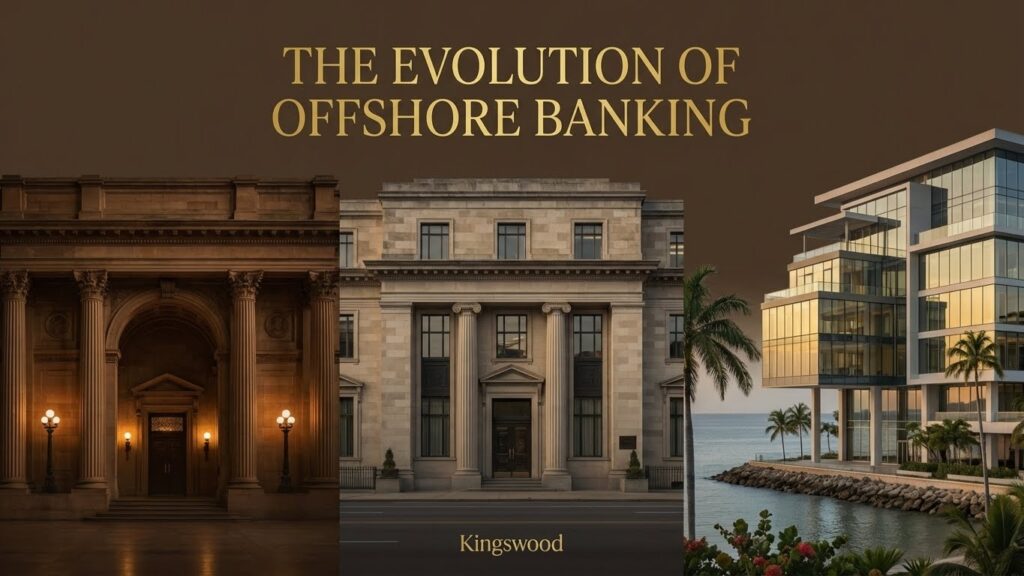
The evolution of offshore banking
Offshore banking – the practice of holding assets and accounts in foreign jurisdictions – has long underpinned global wealth strategy. From the Mediterranean city-states to today’s digital finance hubs, clients have sought “efficiency, privacy, and global access” for their capital. In the early 20th century, for example, Switzerland pioneered modern bank secrecy: its 1934 Banking Act criminalized the disclosure of client information. This “absolute silence” law, enacted amid regional turmoil and tax pressures, set the template for confidentiality that would draw funds from around the world. Likewise, in the 18th and 19th centuries Britain’s Channel Islands (Jersey, Guernsey) and the Isle of Man began to offer special legal regimes – low taxes and simple incorporation – to attract capital from wealthy residents seeking protection from mainland taxes. These early havens were the precursors of the sophisticated offshore system that followed.
After World War II, offshore banking surged as global trade and finance expanded. Regulatory constraints and capital controls at home drove banks and corporations to shift activities abroad. By the 1950s, offshore banking had become the core of international lending and borrowing, as financial groups used foreign units to raise dollars and offer foreign-currency loans. A classic example was London’s Eurodollar market: U.S. dollars deposited and lent outside U.S. supervision enabled higher interest rates and cross-border funding. In practice, lenders and borrowers increasingly operated in offshore markets (currencies foreign to both parties) so extensively that by the 1970s the bulk of international bank claims was booked in offshore centers. This era saw London emerge as the leading hub (especially for USD business) while New York’s dominance faded for offshore clearing.
Key developments in offshore banking:
1934: Switzerland’s Banking Law enshrines absolute client secrecy.
1950s: Rise of Eurodollar and Eurocurrency markets; London becomes global clearing center.
1960s–70s: Caribbean and Asian centers are created. The Bahamas, Cayman Islands, Bermuda and others enact zero/low-tax laws to attract banks and funds. (For example, Cayman legislated in the 1960s to exploit its zero-tax status.) Hong Kong and Singapore emerge as offshore banking hubs in Asia.
1980s–90s: Multinationals use offshore accounts and corporations extensively for cash management and tax planning. Offshore centers broaden services to include investment funds, trusts and corporate structuring.
2000s: Global regulators respond. The U.S. enacts FATCA (2010) requiring foreign banks to report on U.S. clients, and the OECD’s Common Reporting Standard (CRS) mandates automatic information exchange across jurisdictions. These measures effectively ended the era of blanket secrecy.
2016: The Panama Papers leak (11.5 million records) exposes how politicians, financiers and celebrities use offshore structures. Worldwide, tax authorities intensify scrutiny of cross-border accounts.
2020s: Digital finance transforms offshore banking. FinTech platforms and even crypto-related businesses seek offshore licenses, and hybrid models emerge (for example, Puerto Rico’s “International Financial Entity” scheme) that combine offshore benefits with strong regulatory oversight.
From Secrecy to Scale
The golden age of offshore banking was marked by rapid growth of “mailbox” banks and correspondent networks. Small island and special-status jurisdictions built up full-service banks, trust companies and markets serving non-residents. The Caymans, for instance, moved from subsistence economy to an international financial center in a few decades: legislation in the 1960s and 70s capitalized on its tax-neutral status. These centres offered high-yield deposits and convenience banking with minimal disclosure. Corporations and wealthy individuals used them to diversify portfolios, hedge currency risk, and mitigate political or legal risk at home. In essence, offshore banking became a routine part of global finance: by one estimate, over 60% of world GDP was intermediated through international (mostly offshore) banking by 2007.
This scale also drew attention. By the 1980s, concerns about money laundering and illicit flows prompted rules like the Financial Action Task Force (FATF) guidelines and stricter due diligence. National laws – e.g., the USA PATRIOT Act (2001) – expanded oversight of offshore transactions. The cumulative effect was a gradual erosion of opaque haven practices. For example, what was once a core promise – anonymity – has been curtailed. Most offshore banks now adhere to global standards: beneficial ownership registers, Know-Your-Customer checks, and interbank reporting. Automatic exchange regimes (FATCA and CRS) force banks in typical havens to identify account holders’ home countries and share data. As a result, clients today enjoy privacy and protection under law, but not absolute secrecy.
The transformation is striking. “Secrecy alone is no longer the primary selling point,” notes one industry analyst. Instead, reputations are built on stability, expertise and compliance. Traditional havens like Switzerland, Luxembourg or the Cayman Islands emphasize robust legal frameworks and reputable banking systems, not just tax breaks. Indeed, offshore banking has adapted to changing economic and political environments, emerging as a legitimate and vital part of finance. In practice, this means offshore banks focus on structured solutions: international cash management, asset protection trusts, estate planning and global payment services.
Modern Offshore Strategies
In the 2020s, offshore banking continues but in evolved form. Key trends include:
Hybrid jurisdictions
Some places blend onshore credibility with offshore privileges. Puerto Rico’s International Financial Entity (IFE) regime (since 2013) is a prime example. It offers a low 4% tax rate and exemption from FATCA/CRS reporting, while operating under U.S. law with Federal Reserve access. For investors and banks, this “best of both worlds” attracts U.S. and global clients with full confidence in oversight. Other U.S. territories and EU “ring-fenced” regimes play similar roles.
Digital and fintech innovation
FinTech companies often choose offshore licenses to reach international markets. Some online banks and payment platforms establish in favorable jurisdictions to provide borderless services. Cryptocurrencies and stablecoins have also blurred lines; while major crypto exchanges are under scrutiny, small offshore hubs (e.g., Malta, Gibraltar, certain Caribbean states) have courted blockchain firms with tailored regulations. This makes offshore banking more technology-driven and diverse than ever.
Remote and lifestyle banking
The rise of digital nomads and global entrepreneurs has fueled demand for multi-currency accounts and digital wealth management. Offshore banks now advertise “global nomad” services, often emphasizing ease of account opening and online banking for internationals. While not a substitute for residency, such banking options complement the offshore toolkit of high-net-worth individuals who travel or live abroad.
Through these shifts, some constants remain. Clients still value wealth structuring: using offshore banking alongside trusts, foundations or holding companies to protect assets from geopolitical risk or litigation. The notion of jurisdictions as lifestyle choices also persists: locations like Monaco, Dubai or Hong Kong attract residents with low taxes and strong services, and their banking systems are tuned to affluent clientele.
Conclusion
Offshore banking has evolved from opaque vaults of secrecy into transparent yet strategically vital platforms. Its history reflects the tension between client privacy and regulatory oversight. Today’s offshore banks emphasize compliance and credibility even as they serve global clientele. For discerning investors and advisors, offshore banking remains a tool for diversification and sophisticated planning – but now fused with international standards. As one analyst summarizes, “Offshore banks will increasingly position themselves… as innovation-driven platforms connecting businesses and individuals to the global financial system in a transparent, compliant, and efficient way.” In other words, the future of offshore banking is not hidden in secrecy, but built on legitimacy and long-term strategy.