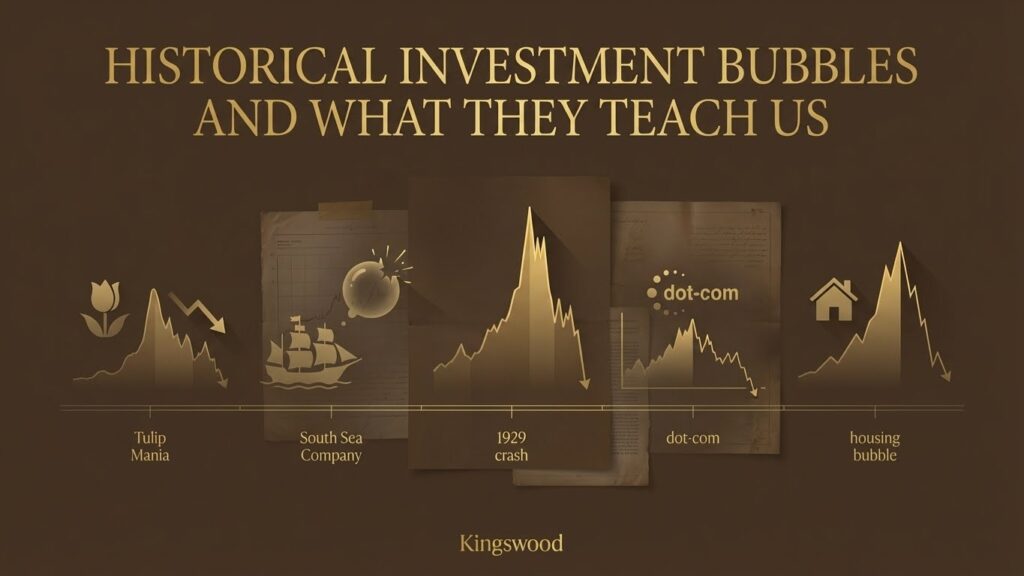
Historical Investment Bubbles and What They Teach Us
Speculative bubbles – episodes when asset prices run far ahead of any fundamental values – have recurred throughout financial history. Economists define a bubble as “an asset price that has risen above the level justified by economic fundamentals.” In practice, bubbles typically follow a familiar pattern: rising prices attract new investors, fueling even higher prices and speculation. This often culminates in a dramatic reversal when confidence evaporates. We consider several famous historical bubbles – from the Dutch Tulip Mania of the 1630s to the modern housing bubble of the 2000s – to understand how each formed, why it burst, and the broad lessons for today. Our aim is to provide clear, structured analysis and takeaways that long-term thinkers can apply, without hype or needless jargon.
Tulip Mania (1634–1637): Early Dutch Speculation
In the 1630s, the Dutch Republic experienced one of history’s first recorded bubbles during the Tulip Mania. Rare tulip bulbs became a speculative frenzy: prices spiraled upwards as buyers of all classes – from shopkeepers to nobility – chased beautifully variegated flowers. At the height of the mania in late 1636, some elite tulips fetched exorbitant sums (about 10,000 guilders each, roughly the price of a fine Amsterdam canal house). Even ordinary citizens were using futures contracts and borrowing on margin, convinced prices would rise indefinitely. In effect, the market detached from any agricultural fundamentals: supply growth could not keep up and many bulbs were traded without ever changing hands for cash.
Within months, the bubble collapsed. By February 1637 buyers refused to honor skyrocketing contract prices, triggering a wave of defaults and bankruptcies. The market crashed so quickly that, according to contemporary accounts, unsold bulbs lost nearly all their value by mid-1637. While the Dutch economy as a whole was not devastated, the episode destroyed many fortunes and trust. Tulipmania remains a model for the general cycle of a financial bubble: once enthusiasm peaks, prices fall rapidly and widespread losses ensue. The main lesson is clear: even a seemingly exotic market can become overheated by speculation, and extreme concentration (everyone owning tulips) carries heavy risk.
The South Sea Bubble (1720): Groupthink and Crash
Nearly a century later in Britain, speculation again ran wild. The South Sea Company, founded to trade in South America and absorb national debt, was endorsed by King George I. Hopes of massive profits drove demand for its shares. In 1720, the company swapped £32 million of government debt for stock, and frenzy took off. Shares soared from a par value of £100 to nearly £1,000 by August. Insider schemes and widespread groupthink (even Isaac Newton lost heavily) fueled the mania.
The bubble peaked in summer 1720, then burst. By December the share price collapsed to about £124, an 80% plunge from its high. Thousands of investors were ruined almost overnight. The fallout was political as well as financial: Parliament investigated fraud and passed the Bubble Act to restrain such schemes. The term “bubble” itself dates from this episode. The events illustrate recurring themes: fraudulent booms and public manias often go hand in hand. The South Sea saga teaches that even when a company appears backed by government or nobility, unchecked speculation can detach prices from real value, setting the stage for a harsh crash.
The Crash of 1929: Roaring Twenties to Depression
In the United States during the 1920s, a prolonged bull market ended in the most infamous crash of modern times. The “Roaring Twenties” saw rapid economic growth, new technologies, and rising living standards. Average Americans flocked into the stock market, often buying on margin with as little as 10% down. This flood of borrowed money drove U.S. stock prices to unprecedented heights: the Dow Jones Industrial Average quintupled in the decade before 1929, reaching about 381 points in September 1929. Asset prices had clearly outpaced fundamentals.
Warnings were ignored. In late 1929, the Fed raised rates to cool speculation, but by then the market was already trembling. Panic set in on October 28–29, 1929 (“Black Monday” and “Black Tuesday”); the Dow fell about 12–13% each day. By mid-November it had lost about half its value. The crash cascaded into a severe downturn, contributing to the Great Depression.
Lessons from 1929 are often debated, but the core insight is that excessive leverage and irrational exuberance can trigger broad fallout. Speculators were buying “on thin air,” and when prices reversed, both banks and businesses failed. Central bankers later concluded that aggressively pricking a bubble can backfire – and that once a crash begins, liquidity support is crucial. For investors, 1929 reaffirms caution: even if most people believe a rally will continue forever, history shows the peak always arrives.
The Dot-Com Bubble (1997–2000): “New Economy” Hype
By the late 1990s, a modern incarnation of bubble fervor gripped the technology sector. New internet and telecom firms dominated markets. Venture capital poured into dot-com startups, and investors eagerly snapped up IPOs with little revenue or clear business models. Markets embraced the idea of a “new era,” believing the internet invalidated traditional valuation rules. Between 1990 and 2000, the Nasdaq went from a relatively small index to representing 80% of the NYSE’s market value.
The bubble peaked in early 2000. Many dot-coms had never made money. When sentiment shifted, the crash was brutal: the Nasdaq fell about 77% from its March 2000 peak to October 2002. Countless startups went bankrupt, and even major firms saw steep declines. The crash contributed to a mild recession in 2001 and shook global tech markets.
The dot-com episode highlights the danger of narrative-driven investing. Wall Street cheered endless IPOs without examining whether businesses were viable. Investors succumbed to irrational exuberance and a feedback loop of optimism. The lesson: innovation does not eliminate risk; valuations must eventually be justified by real earnings.
The Housing Bubble (2000s): Leverage and Crisis
In the 2000s, a similar pattern unfolded in real estate. U.S. home prices doubled between 1998 and 2006 – the sharpest run-up on record. Low interest rates, global capital chasing returns, and new mortgage products all played a role. Lending standards weakened dramatically, including to subprime borrowers. Mortgages were repackaged into complex securities held worldwide, disguising risk. U.S. household mortgage debt surged from about 61% of GDP in 1998 to 97% by 2006.
When prices peaked in 2006–07, defaults rose and mortgage-backed assets began collapsing in value. Funding markets froze by 2008. U.S. home prices ultimately fell more than 20% by 2011. Major financial institutions failed or required massive bailouts. Unlike earlier bubbles, this one was systemic: it brought down banks, impaired international investors, and caused the Global Financial Crisis.
The housing bust’s lessons are profound. Leverage and complexity magnified the damage. Borrowers, banks, and investors all assumed real estate could only rise. When that proved false, the unwind became catastrophic.
Lessons from Past Bubbles
Across these episodes, several themes repeat. History never replicates itself exactly, but it rhymes. Key takeaways include:
Disconnect from fundamentals.
In every bubble, prices detached from reality. Narratives of limitless gains replaced sober analysis. When valuations seem detached from cash flows or profits, caution is warranted.
Leverage amplifies risk.
Borrowed money fuels most bubbles – margin loans in 1929, telecom debt in 2000, mortgages in 2008. Leverage accelerates gains on the way up and losses on the way down.
Herd behavior and sentiment.
FOMO drives bubbles. Rising prices attract new investors, pushing prices higher until the sentiment flips. Independent thinking is vital.
Importance of diversification.
Those who concentrated wealth in the bubble asset suffered the most. Broad diversification across sectors and geographies cushions against bubble-specific shocks.
Regulation and oversight matter.
Every major crash produced reforms. Regulation cannot eliminate bubbles, but transparency, risk controls, and lending standards reduce systemic danger.
Long-term perspective.
Most bubbles eventually give way to renewed growth. The dot-com crash was devastating, but the underlying technologies did reshape the economy. Patient, disciplined investors tend to fare better than those chasing fads.
Ultimately, these episodes teach prudent investors to focus on what is controllable – solid research, risk management, and a long-term plan – rather than chasing short-term thrills. A calm, disciplined, high-signal approach remains the safest way to navigate any future market upheavals.