How Monaco Became the Richest Country
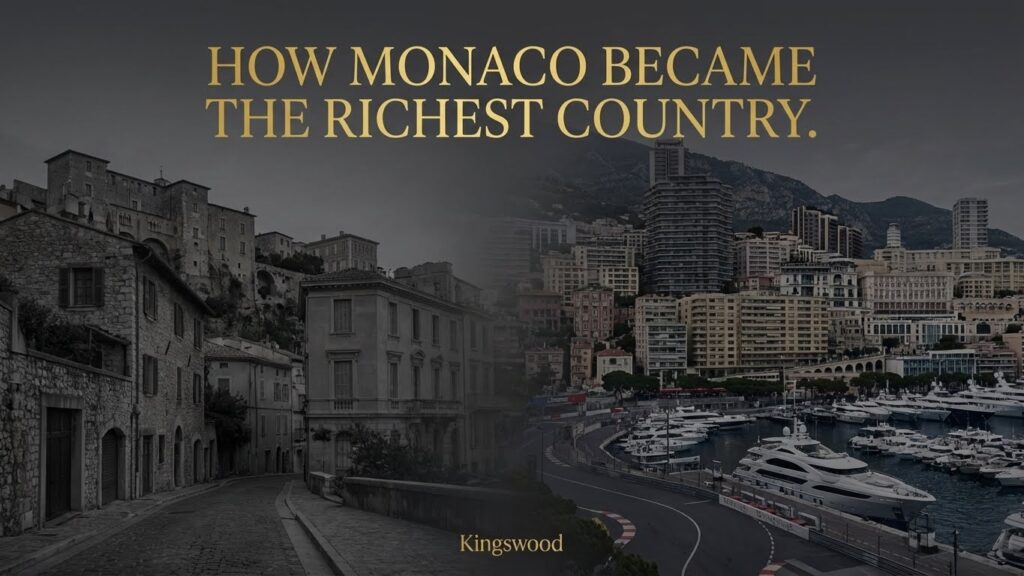
Monaco’s densely built harbor and skyline tell a simple truth: this tiny principality of just 2 km² on the French Riviera has become the wealthiest country on Earth by GDP per capita. As of 2022, its GDP per person was estimated at nearly a quarter of a million dollars—far higher than any other sovereign state. The reason is straightforward but unique: Monaco has engineered an economic ecosystem that attracts global wealth and builds its services economy around it. Finance, insurance, real estate and luxury tourism dominate, reflecting a resident base that is overwhelmingly affluent and international. In practice, the state’s GDP reflects the wealth of the foreign millionaires and billionaires it attracts.
Monaco did not stumble into this position. It built it deliberately.
A Casino and a Country Transformed
Monaco’s modern wealth story begins in the mid-1800s. In 1848 the principality lost most of its agricultural hinterland to France, collapsing its traditional tax base and pushing the Grimaldi dynasty into crisis. Prince Charles III responded with one of Europe’s earliest strategic reinventions: create a leisure and entertainment hub for the elite.
He chartered what would become the Monte Carlo Casino in the 1850s and opened it officially in the 1860s, pairing it with luxury hotels, promenades and cultural institutions. The casino—and particularly its attached opera house—quickly became a magnet for aristocrats and wealthy travelers across Europe. In Charles’s own words, the goal was to make Monte Carlo a “luxuriously beautiful playground for the world’s rich.”
The plan worked. Tourism soared, revenues stabilized, and Monaco began shaping its reputation as a refined enclave for high society. Over the next century, Monaco’s rulers expanded and diversified this foundation. Under Prince Rainier III, Monaco modernized its infrastructure, broadened beyond casino tourism and positioned itself as a global center for private banking, insurance, real estate and high-value services. Today Monaco’s economy remains overwhelmingly service-based, but with a sophistication and margin structure shaped by its ultra-wealthy residents.
Tax Policy and the Private-Wealth Magnet
The cornerstone of Monaco’s economic strategy is its fiscal model: no personal income tax. Since 1869, residents of Monaco (other than French citizens covered by a bilateral treaty) have paid zero income tax. The principality also levies no capital-gains, wealth, property or inheritance taxes. Instead, the state relies on indirect taxes—principally a 20% VAT—along with company taxes, license fees and the proceeds of state monopolies such as tobacco and gaming.
This policy was a defensive reaction to Monaco’s 19th-century crisis: Charles III wanted to ensure that Monaco would never again lose its population or tax base. In practice, the model proved transformative. Wealthy individuals and entrepreneurs quickly recognized Monaco as a rare jurisdiction offering political stability, world-class infrastructure, and essentially no personal tax burden. Over time, Monaco embraced the identity of a low-tax private-wealth hub. Residency requires proving financial self-sufficiency—usually through substantial bank deposits and secure local housing—but offers no special tax exemptions because the default system is already the incentive.
Today, roughly three-quarters of Monaco’s economic output is driven by activities linked to affluent foreign residents and their businesses. Estimates suggest that between one-third and nearly half of residents are millionaires or billionaires. In short, Monaco imports wealth as its primary economic fuel.
Finance, Insurance and Real Estate
The financial sector grew naturally around this capital influx. Monaco is now a major private-banking jurisdiction, with bank assets vastly exceeding national GDP. Wealth-management firms, family-office services and specialized insurers dominate the domestic economy. Scientific, professional and support services—many of them catering to cross-border business owners and high-net-worth families—form another substantial segment.
Real estate is a cornerstone industry as well. Monaco’s property market is the most expensive in the world. With only 2 km² of land and strict planning controls, supply is constrained even after decades of land reclamation from the sea. Luxury towers, sky-high rents and limited housing availability are structural features of the economy, not temporary distortions.
Tourism remains significant, particularly high-spending visitors drawn to the casino, cultural institutions, fine dining, and major events such as the Monaco Grand Prix and international yacht shows. While smaller than banking or real estate in GDP share, luxury tourism reinforces Monaco’s global brand and contributes meaningfully to state revenue.
Monaco’s customs union with France and its euro-currency arrangement ensure seamless trade and financial flows. The result is a tightly integrated, high-margin services ecosystem.
Lifestyle, Luxury and Stability
Monaco sells not just tax efficiency, but lifestyle: discretion, safety, social prestige and dependable governance. The principality is one of the safest places in the world, with extremely low crime and a large, visible security presence. Public services—from healthcare to cultural institutions—are exceptional. Unemployment is minimal and serious poverty is effectively nonexistent.
The ruling Grimaldi family has maintained political stability for more than seven centuries, enabling long-term planning and consistent economic policy. This stability is a key asset for wealthy families seeking predictability.
Foreign nationals make up the overwhelming majority of residents, while native Monegasques represent less than a quarter of the population. Foreigners cannot easily naturalize, meaning Monaco’s domestic politics remain consensus-driven and focused on preserving social harmony rather than mass redistribution. In practice, Monaco functions like a high-end mercantile state: it sells stability and prestige to the wealthy, who in return support the state through high levels of consumption and indirect taxes.
VAT revenue alone—powered by luxury spending—represents more than half of government income. Fiscal surpluses and substantial sovereign reserves allow Monaco to avoid public debt and maintain high public service standards. This reinforces the cycle of attractiveness.
Ongoing Scrutiny and Challenges
Monaco’s model invites scrutiny. International bodies have raised periodic concerns about transparency and financial oversight. The principality was once labeled a tax haven and more recently has been placed under increased monitoring for anti-money-laundering reforms. Although Monaco has strengthened regulation significantly, reputational risks remain inherent to a wealth-driven financial hub.
The economy is also vulnerable to scale constraints. With little land and a narrow sectoral base, Monaco is exposed to downturns in global finance, luxury tourism and real estate. Meanwhile, its deep integration with France and alignment with EU VAT rules require careful diplomatic and regulatory navigation, especially as global tax standards evolve.
Nonetheless, Monaco’s economic model has shown resilience. The post-COVID rebound was strong, with record GDP figures and expanding reserves. Monaco’s long-standing political continuity and conservative fiscal management provide buffers against shocks.
Conclusion
Monaco became the richest country in the world not by producing vast quantities of goods, but by designing a system that attracts and concentrates wealth. A 19th-century casino, a 19th-century tax decision, and a 20th-century expansion into finance and luxury services laid the foundations. Today Monaco’s value proposition—privacy, security, refined living, elite networks and predictable low taxes—continues to draw the global affluent.
The principality’s success shows what a micro-state can achieve when policy, brand and geography align. It is both a case study in strategic national positioning and a reminder that prosperity, when curated carefully enough, can be concentrated into a single square mile of stone and sea.