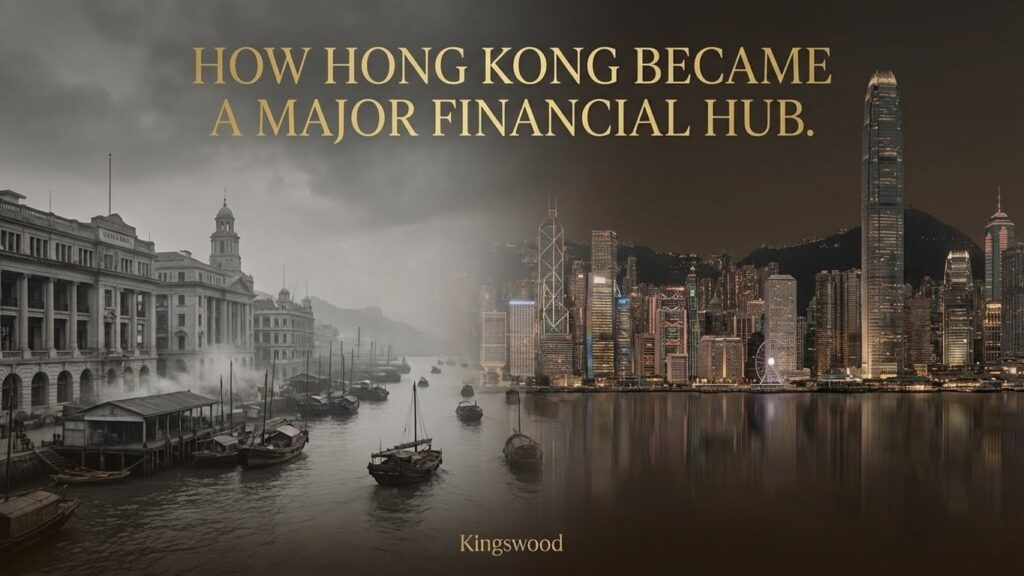
How Hong Kong Became a Major Finance Hub
Hong Kong is widely recognized as one of the world’s foremost international financial centres. It combines a free-market economy with a robust regulatory framework and strong global linkages, making it a key gateway between Asia and the West. In the 2025 Global Financial Centres Index, Hong Kong ranked third worldwide and first in the Asia-Pacific region. The city’s financial sector is a pillar of the economy: in 2023 it employed roughly 269,100 people (about 7.3% of the workforce) and generated nearly 25% of GDP. These enduring strengths reflect Hong Kong’s history of open trade, sound institutions and strategic policies that together have made it a durable hub for global finance.
Historical Foundations
Hong Kong’s financial prominence has deep roots. After Britain established colonial rule in 1842, Hong Kong “quickly became a regional center for financial and commercial services” linked to China’s trade. Merchant banks and trading houses – epitomized by the founding of The Hongkong and Shanghai Banking Corporation – anchored the city’s growth into the 20th century. Throughout the mid-20th century, turmoil on the Chinese mainland often drove capital and expertise into Hong Kong’s more stable port, allowing the city to accumulate wealth and know-how even as mainland trade was disrupted. Over time Hong Kong evolved from a simple entrepôt into a sophisticated finance centre.
In 1997 Hong Kong’s return to China was governed by the Basic Law under “one country, two systems,” which explicitly preserved Hong Kong’s separate economic and legal system. This framework allowed Hong Kong to sustain its capital-market orientation after the handover. For example, during the Asian financial crisis of 1997–98 Hong Kong (like mainland China) maintained its US-dollar currency peg rather than devaluing, which helped stabilize its markets. In the crisis’s aftermath, Hong Kong’s prospects became even more closely tied to China’s growth – solidifying the city’s role as China’s primary offshore financial center. In sum, Hong Kong’s history of free trade, rule of law and connectivity laid the groundwork for its later rise as a global finance hub.
Foundational Pillars of Hong Kong’s Financial Hub
Prime Geography and Connectivity: Situated “at the heart of Asia,” Hong Kong links Western and Asian markets. Its time zone bridges New York and Shanghai, and the city has extensive global financial networks and low trade barriers, enabling efficient 24-hour capital flows.
Rule of Law and Stability: Hong Kong retains a common-law legal system and independent judiciary. It allows virtually unrestricted capital flows and maintains a long-standing US dollar peg (the Linked Exchange Rate System), which anchors the currency even through international volatility. These features – protected by the Basic Law – foster investor confidence and safeguard property rights.
Open Economy and Tax Regime: The city’s policies emphasize openness and simplicity. Hong Kong’s direct taxes are comparatively low, and it famously has no capital gains or estate taxes. Together with a territorial tax system, this regime encourages businesses and high-net-worth individuals to retain and invest wealth in Hong Kong.
Robust Markets and Institutions: Hong Kong offers a full suite of financial infrastructure. Its stock market (HKEX) is Asia’s largest and was the world’s ninth-largest by capitalization (~HK$34 trillion as of Nov 2024). The city hosts hundreds of banks, fund managers, insurers and professional services firms, offering a wide range of products and advice. Regulators like the HKMA and SFC are respected internationally for transparent and efficient oversight.
Gateway to Mainland China: Uniquely, Hong Kong serves as a bridge to the Chinese economy. It is the world’s largest offshore renminbi centre and has the primary infrastructure (Stock Connect, Bond Connect, etc.) for foreign investors to reach Chinese markets. Under “one country, two systems,” Hong Kong’s financial linkages with the Mainland have grown ever deeper – attracting Chinese firms and capital and positioning Hong Kong as the base for cross-border finance.
These pillars – geographic, institutional and economic – combine to make Hong Kong resilient. Even as other cities vie for business, Hong Kong’s blend of global infrastructure and local advantages keeps it at the forefront of international finance.
Integration with Mainland China
Hong Kong’s special relationship with the Chinese mainland has been central to its finance hub status. As China’s economy opened from the late 1970s onward, Hong Kong became a bridge for capital and expertise. Between 1978 and 1997, trade between Hong Kong and China grew at an average of 28% per year, and Hong Kong firms invested tens of billions of dollars into nearby Guangdong Province. This integration meant Hong Kong’s markets gained a unique role: it became the primary venue for Chinese companies to raise offshore capital and for Mainland investors to access global markets.
In recent years, policymakers have built out cross-border financial schemes to reinforce this bridge. Hong Kong launched Stock Connect (linking to Shanghai and Shenzhen equities), Bond Connect (linking to Mainland debt markets), and Wealth Management Connect (linking Guangdong-Hong Kong) – all designed to facilitate Chinese and international capital flows via Hong Kong. These mechanisms channel Mainland liquidity through Hong Kong’s markets while giving Chinese investors easier access to overseas assets.
Government leaders now explicitly refer to Hong Kong as a “super connector” between China and the world. Analysts note, for example, that under China’s Belt and Road Initiative Hong Kong’s strengths in green finance and its status as the largest offshore yuan hub will allow it to capture a growing share of cross-border investment. In short, Hong Kong’s financial role is in large part defined by how effectively it links the Mainland to global capital.
Financial Markets and Infrastructure
Hong Kong’s own market infrastructure evolved from these advantages. The Hong Kong Stock Exchange (HKEX) today is a global heavyweight: it hosts over 2,600 listings and is the primary international venue for Chinese firms. Unlike mainland exchanges, Hong Kong’s market operates under an international-style regulatory regime, permitting broad foreign participation. This open market environment has attracted a steady pipeline of IPOs – for example, in the first half of 2025 Hong Kong companies raised more than HK$76 billion in IPOs, nearly matching all of 2024’s total. Regulatory reforms in recent years (such as new boards for tech and biotech companies and streamlined listing rules) have been introduced to broaden and deepen the markets.
Hong Kong also boasts a large debt market. It is the world’s largest offshore renminbi (CNH) debt center, with “dim sum” bond issuance growing rapidly (outstanding volume reached over RMB1.27 trillion in early 2025). The HKMA and regulators have continued to enhance market infrastructure – for example, by introducing a cross-boundary repo facility for RMB bonds – to make Hong Kong an efficient hub for bond issuance and liquidity. On the banking side, over 150 international banks maintain operations in Hong Kong (many using it as an Asia or global base), providing world-class liquidity and credit. This concentration of capital markets, banking, and professional services (backed by a top-tier legal environment) underpins Hong Kong’s role in global finance.
Wealth Management and Private Banking
Beyond capital markets, Hong Kong is a premier wealth-management centre. Its banks and family offices serve affluent clients from across Asia and the West. Recent industry surveys show a resurgence of confidence: by 2025, 100% of local private bankers were optimistic about the outlook, and assets under management in Hong Kong’s wealth sector rose about 15% (to HKD 10.4 trillion) over the prior year. Mainland China remains the largest source of this wealth – roughly 57% of Hong Kong’s managed assets come from Mainland clients (a share projected to rise). Clients cite Hong Kong’s comprehensive financial ecosystem (fund managers, fiduciaries, trustee services) and its transparent regulatory and tax framework as key reasons to center their wealth here.
Hong Kong has seen robust growth in financial professionals as the city’s global appeal returns. In the three years to mid-2024, the number of hedge funds, private equity offices and family offices relocating to Hong Kong rose by 24%, and major funds have announced further moves in 2025. The government has introduced incentives – for example, a 2024 waiver on taxes for certain cryptocurrency and alternative investment gains for qualifying funds – to attract international managers and capital. With licensing levels (e.g., securities licenses) at record highs, these developments complement Hong Kong’s core wealth-management industry and reflect strong confidence in the city as a leading global hub for sophisticated capital.
Global Recognition and Outlook
Hong Kong’s global standing is confirmed by international benchmarks. In the 2025 Global Financial Centres Index it placed #3 worldwide (behind New York and London) and remains Asia’s top-ranked center. The city leads global peers in areas such as investment management, insurance and banking services. Credit rating agencies likewise affirm Hong Kong’s strength: Standard & Poor’s and Moody’s both maintain top-tier ratings for the SAR (AA+/Aa3) with stable outlooks. In their reports, analysts specifically cite Hong Kong’s large fiscal reserves, strong external balance sheet and the stabilizing role of its dollar-linked exchange rate as key credits. Financial indicators underscore this resilience: Hong Kong’s bank deposits and capital markets remain healthy, and IPO fundraising has surged to multi-year highs.
Looking ahead, Hong Kong’s government and business community emphasize continuity and innovation. Officials reaffirm leveraging Hong Kong’s “institutional advantages” under one country–two systems and its role as a “super-connector” in China’s economic vision. At the same time, Hong Kong is proactively advancing new initiatives – for example, issuing a sustainability disclosure roadmap (aligning with international green finance standards) and implementing licensing for digital assets and virtual banks – to attract fresh capital and talent. While geopolitical headwinds and global competition persist, Hong Kong’s core attributes (legal stability, full market access, and deep financial expertise) suggest it will remain among the world’s elite financial centres.
In summary, Hong Kong’s ascent as a global finance hub reflects centuries of open trade, strong institutions and strategic integration with the Chinese economy. By maintaining high-quality infrastructure, an investor-friendly environment and international credibility, Hong Kong continues to rank among the world’s elite financial cities. These enduring foundations – together with ongoing reforms – explain how Hong Kong has become, and will likely remain, a major centre of global finance.